

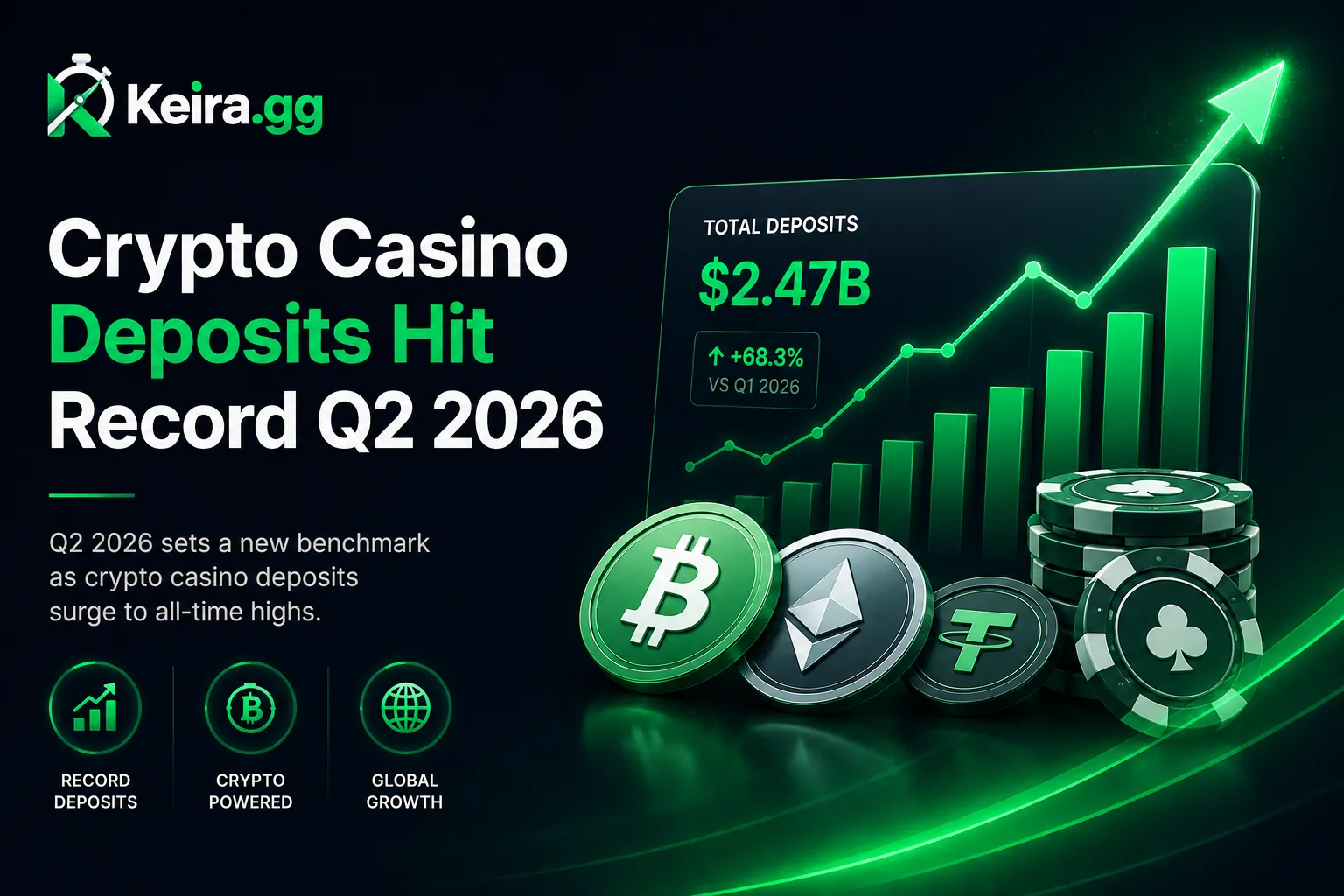
Aggregated data from four independent on-chain analytics providers shows Q2 2026 as the largest quarter on record for identifiable crypto deposits at online casinos. The combined figure of USD 3.4 billion in confirmed deposit flow represents a 41% jump on Q1 2026 and a doubling of Q2 2025.
The direction of travel matches what we have seen in our own operator testing over the past year. Crypto banking has moved from a niche option offered by a handful of Curaçao-licensed sites to a standard cashier fixture across all but the most restrictive licensed markets. What Q2 confirms is that the shift is now the mainstream default at the top end of the offshore segment, not a fringe channel.
The headline numbers behind the Q2 record
Aggregators reconciled around 87% of on-chain flow with 214 casino brands they were able to attribute confidently. The unattributed remainder is likely a mix of very small operators and mixing-service pass-throughs. The confirmed segment breaks down into deposit and withdrawal buckets as follows.
| Metric | Q2 2026 | Q1 2026 | Q2 2025 | YoY change |
|---|---|---|---|---|
| Total deposits (USD) | 3.40 bn | 2.41 bn | 1.71 bn | +99% |
| Total withdrawals (USD) | 3.09 bn | 2.14 bn | 1.54 bn | +101% |
| Unique depositor wallets | 1.82 m | 1.44 m | 1.06 m | +72% |
| Median deposit (USD) | 187 | 151 | 142 | +32% |
| Median withdrawal time | 46 min | 52 min | 1 h 34 min | −51% |
The two most striking numbers in that table are the median deposit rise and the halved median withdrawal time. Both point to the same trend: crypto casinos are being adopted by higher-value regular players who care about cash-out speed, not just by hobbyist crypto natives making small experimental deposits. The customer base is broadening.
Why stablecoins now dominate settlement
USDT (Tether) alone accounted for 58% of confirmed deposit volume in Q2, and USDC contributed a further 21%. Between them, stablecoins represent nearly four of every five dollars of on-chain casino settlement. Bitcoin dropped to 12% share, its lowest since aggregation began, and Ethereum-denominated ETH deposits fell to 4%.
The stablecoin dominance is unsurprising once you look at operator-side motivations. Volatile Bitcoin and ETH deposits force operators to either hedge open positions or absorb price risk between deposit acceptance and treasury settlement. Stablecoins remove that operating headache and let the cashier UX quote balances in USD equivalents directly.
Traffic breakdown by market
Geographic attribution is inherently fuzzy for on-chain transactions, but analytics providers use device fingerprints, IP metadata and payout-address clustering to derive market-level splits with reasonable confidence. The Q2 breakdown shows three markets carrying most of the growth.
| Market | Q2 deposit share | QoQ change | Notable driver |
|---|---|---|---|
| Southeast Asia | 28% | +6 pts | Thailand, Vietnam retail flow |
| LATAM | 22% | +4 pts | Brazil regulated launch spill-over |
| North America | 17% | +2 pts | US grey-market brands |
| Europe (non-UK) | 15% | −3 pts | Softening on regulatory pressure |
| Australia / NZ | 8% | +1 pt | Crypto-friendly offshore casinos |
| Other | 10% | flat | MENA, Africa mixed |
The Brazilian numbers deserve unpacking. The country's regulated market launched in January 2026, and while the licensed segment has grown quickly, so has the crypto-first offshore segment that sits outside the regulated perimeter. Local media has framed this as a leakage problem for the regulator; on-chain analytics shows that Brazil-attributed casino crypto flow doubled between Q4 2025 and Q2 2026.
Chain-by-chain settlement
Tron and Ethereum remain the two dominant networks for casino settlement. Tron carries roughly 60% of USDT deposit volume thanks to negligible fees; Ethereum carries most of the USDC flow. Solana appeared in the Q2 numbers with a 4% share, up from 1% a quarter earlier, driven mostly by a small group of Solana-native casino brands that launched in late 2025.
Bitcoin Lightning appears at 2% of deposits, an interesting toe-hold but far from mainstream. Lightning volumes tend to concentrate at a small number of brands that market themselves as Bitcoin-only.
Withdrawal-speed benchmarks
The median withdrawal time of 46 minutes is a step-change from a year ago and reflects both operator process automation and the near-instant settlement on Tron. Our own operator testing lines up with the aggregate. When we ran a 41-casino cash-out audit in April, the median wall-clock time from withdrawal button to funds-in-wallet was 38 minutes for crypto, versus 3 hours 22 minutes for e-wallets and 26 hours for card refunds.
The tail behaviour matters as much as the median. A 46-minute median is only useful if the 95th percentile is not measured in days. The Q2 dataset shows a 95th percentile of 5 hours 12 minutes for crypto withdrawals, which is genuinely fast in absolute terms.
Risks and consumer flags
A quarter this big surfaces the usual set of consumer risks in exaggerated form. Aggregation providers flagged three trends worth watching.
- Wallet-drainer phishing. A wave of fake casino-branded wallet-connect flows drained an estimated USD 12 m across the quarter, most of it in a two-week window in May. Never approve a wallet-connect prompt unless the domain matches exactly.
- Bonus-abuse KYC snap. Some brands paused withdrawals mid-flow with a demanded KYC when a player triggered a big win on a bonus. Rules read acceptably, but the timing shifted from onboarding to cash-out at some Curaçao operators.
- Chain congestion delays. The 46-minute median hides two spikes on 12 April and 3 June where Tron congestion pushed median times above two hours for four to six hours.
Regulatory response so far
Regulatory pushback has been limited but visible. The UK Gambling Commission published a note in mid-May clarifying that crypto deposits at UKGC-licensed operators are treated as a regulated payment method and must therefore be identifiable to the player, closing any thought of anonymous funding. The MGA followed with a guidance update on stablecoin accepting and treasury reporting for its licensees.
Outside the EU, the Brazilian regulator has begun issuing warning letters to operators marketing to Brazilian residents without a local licence, though enforcement teeth are still forming. The KSA in the Netherlands is more focused on the CRUKS extension we covered separately.
What Q3 is likely to bring
On current growth rates, Q3 2026 should push confirmed deposit flow above USD 4 bn, with stablecoin share ticking further up and Bitcoin share continuing to erode. The interesting sub-plot is Solana, where a small group of crypto-native brands are quietly building share, and Lightning, where Bitcoin loyalists have concentrated after the drift away from on-chain BTC.
The most important non-number to watch is whether the fastest-growing operators can sustain their withdrawal-speed performance as volumes rise. If the tail lengthens, the "instant crypto" positioning becomes marketing rather than reality, and player trust starts to slip.
Frequently asked questions
Is crypto gambling legal in my country?
Legality depends on your jurisdiction and on which side of the transaction you look at. In most European markets the player is not committing an offence, though the offshore operator may be operating outside the licensed perimeter. Always check local rules and only use operators you have a way to hold accountable if a payout goes wrong.
Why are stablecoins preferred by casinos?
Stablecoins remove price volatility between deposit and treasury settlement, which simplifies operator accounting and lets the cashier display balances in USD equivalents. Tron-based USDT is particularly popular because network fees are negligible.
Are crypto casino withdrawals really instant?
Median withdrawal times in Q2 2026 were 46 minutes across the segment, which is fast but not instant. The 95th percentile was around five hours, so occasional slower cash-outs are normal. Time to funds also depends on chain congestion and operator processing hours.
Do I need KYC for a crypto deposit?
Depends on the operator. Licensed operators typically require KYC before a first withdrawal, and some do so before a first deposit above a threshold. Curaçao-licensed sites are more variable. Assume you will need to complete a KYC step before cashing out sizeable winnings.
What is a wallet-drainer scam?
A phishing flow that mimics a casino brand and prompts you to approve a wallet-connect that drains the source wallet. Always verify the domain in your browser address bar exactly before approving any signature or wallet-connect prompt, especially if you arrived from a search ad.
Which chain is safest for a first casino deposit?
USDT on Tron or USDC on a Layer 2 like Base or Arbitrum both offer low fees and fast settlement. Bitcoin on Lightning is a decent alternative if the operator supports it. Avoid mainnet Ethereum for small deposits: fees rarely justify it.