

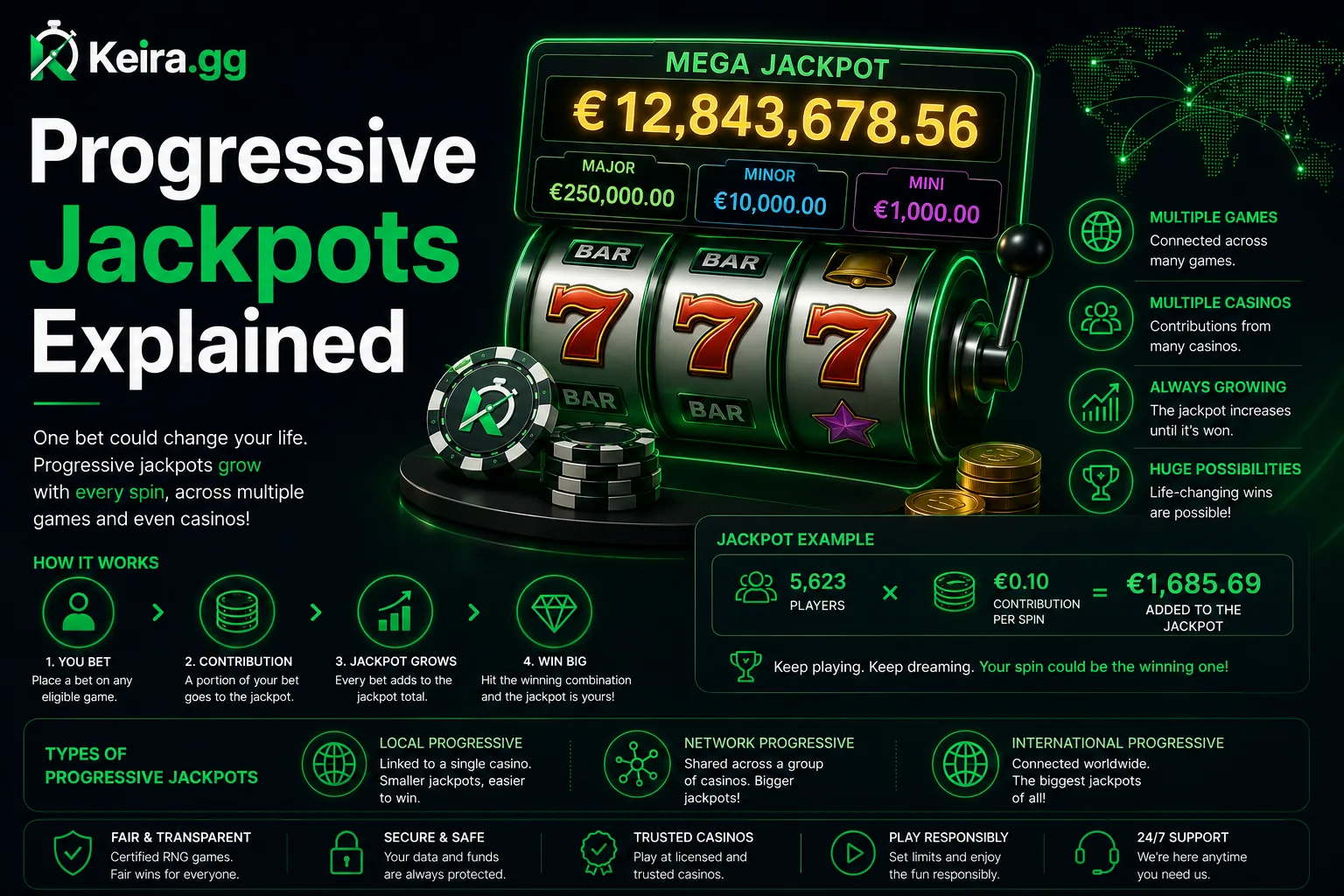
How a progressive jackpot is built
A progressive is funded by a percentage of every stake, sometimes as much as five per cent, sometimes as little as half of one per cent. That percentage comes out of the game's RTP. A slot advertised at 96 per cent RTP with a 1 per cent progressive contribution is really a 95 per cent RTP base game plus a lottery ticket built into every spin.
Network, local and standalone pools
Network progressives combine contributions across every operator that runs the game, which is why the totals reach eight figures. Local progressives are pooled at one operator (or one operator group) and typically peak in the six figures. Standalone progressives sit inside a single game and refill slowly. The odds of hitting the top prize get smaller as the pool gets bigger; the network jackpots that make the news are also the ones that hit an individual player once in every hundreds of millions of spins.
How the jackpot actually triggers
Three trigger types dominate 2026 progressives. A symbol combination: a specific rare alignment of jackpot symbols. A bonus round pick: entry via a base bonus, then a wheel or picker inside decides the level and, occasionally, the top prize. A random any-spin trigger: mathematically eligible on every spin, higher-eligibility at higher stakes. Read the info page to know which type your slot uses; it decides whether higher stakes materially increase your hit probability.
Real odds of a big hit
Published odds are rare but derivable. If a top pot pays out roughly monthly and the total spins across the network are, say, ten billion a month, the base rate is one in ten billion per spin. At one euro per spin, that is 10 EUR of stake per hit-expected. At ten euro per spin (still small), 100 EUR of stake per hit-expected. You are not likely to hit it. The point of the pool is that someone hits it, and the game is fun in the meantime.
Seeding, must-drop and expected value
After a hit, the pool resets to a seed value that the game guarantees. On old-school progressives that was a small fraction of the top prize; on modern must-drop jackpots the seed is set high enough that the pot must fall before a deadline (typically a time or size cap). Must-drop progressives are the only progressives where you can calculate expected value: when the pot is closer to its trigger than usual, the game briefly pays more than 100 per cent RTP. Small edge, entertaining edge.
The big names in 2026
Mega Moolah still runs. Divine Fortune still runs. Age of the Gods, Jackpot King and Wolf Gold all have progressive editions. Newer entrants include Push Gaming's Retro Tapes hunt jackpots and Relax Gaming's Dream Drop family, both of which use must-drop mechanics that some players time to the near-guaranteed drop window.
If you are going to play progressives
| Do | Do not |
|---|---|
| Play a session-sized bankroll only | Chase a specific pot with rent money |
| Prefer must-drop over open-ended pools | Play any progressive at the minimum stake if the info page shows top-prize eligibility is stake-scaled |
| Read the info screen for the trigger type | Assume a bigger bet meaningfully changes the odds without checking |
| Enjoy the maths for what it is | Treat the jackpot as a plan |
Seed values and hit thresholds are the key numbers
Every progressive jackpot starts at a "seed" figure: the base amount from which the jackpot rebuilds after a win. Well-designed jackpots publish both the seed and the current pot, and diligent readers watch the ratio. A jackpot that sits at 10× its seed has, on average, become much more attractive than one that sits at 1×.
| Jackpot | Type | Typical seed | Average hit | Hit frequency |
|---|---|---|---|---|
| Mega Moolah (Microgaming) | Network-wide | EUR 1 m | EUR 4-8 m | Roughly every 90-120 days |
| Mega Fortune (NetEnt) | Network-wide | EUR 250,000 | EUR 2-5 m | Roughly every 60-90 days |
| Divine Fortune | Local (per casino) | EUR 100,000 | EUR 300k-800k | Weekly to monthly per casino |
| Age of the Gods (Playtech) | Network-wide four-tier | Varies by tier | EUR 5,000-2 m | Multiple daily at lower tiers |
| Daily Drops (various) | Time-locked | EUR 500 | EUR 500-5,000 | Guaranteed daily |
Progressive jackpots have lower base RTP
The pot is funded from a share of every wager. That share, typically 1-3%, comes out of the player-return column of the RTP. A jackpot slot that advertises a 96% RTP often runs at 92-93% for the non-jackpot component, with the balance flowing into the pot. This is not a scam; it is how the funding maths works. The trade-off is a long tail of small losses in exchange for a very small chance of a very large win.
The corollary is that progressive slots are a poor choice for wagering-through a bonus, and many operators exclude them from bonus play entirely. Check the game-weighting table on any bonus offer before assuming a jackpot slot counts.
A rational way to play jackpots
Chasing a "must-win-before" jackpot is genuinely rational as an expected-value calculation: as the pot rises, the effective RTP of the game rises with it. The problem is that variance is enormous and the required bankroll to survive the wait is unrealistic for a private player. Treat any jackpot session as entertainment with a very small chance of a life-changing outcome, and set stakes and time limits accordingly.
How pooling and network share affects the odds
Networked jackpots (Mega Moolah, Mega Fortune) accumulate across every casino carrying the game. Local jackpots (per-casino Divine Fortune, in-house progressives) build only from that casino's players. The trade-off is straightforward: networked pots grow faster but hit rarer; local pots grow slower but hit more often. Neither is strictly better; both are choices about volatility.
Closing thoughts on jackpot play
The most important reality check is that expected value is not entertainment value. A jackpot spin at 92% RTP is a bad bet in the expected-value column, but the emotional payoff of the pursuit is what many players are actually buying. Being honest about that trade-off — treating jackpot play as a small entertainment premium rather than a savings plan — is the difference between playing them well and playing them badly.
Local jackpots deserve more attention than they get
Networked jackpots grab the headlines because their pots are gigantic. Local jackpots — the smaller in-house pots that build off a single casino's traffic — are often the better maths bet, because their seeds are proportionally larger relative to average hit size, and hit frequency is higher. Divine Fortune's local pool at a mid-size casino can hit a EUR 800,000 payout within a fortnight of the seed reset, at a fraction of the volatility of a mega-network game.
The reason most players ignore them is marketing. Casinos push the big networked names because the pots are advertised across the network and drive traffic. Local pots are quiet, and finding them means checking the operator's jackpot page rather than the front-page carousel.
A final practical note on jackpot sessions
Set the session bankroll to a level you would spend on any recreational evening, treat the win as a small-probability bonus rather than an expectation, and log every session so you can review your total spend over three months. If the total is more than your entertainment budget expected, you are probably chasing rather than playing, and the tools you built in the bankroll guide apply here too.
FAQ
What are the odds of hitting a network progressive jackpot?
Vanishingly small, and specific to the game. As a rule of thumb, network pots that pay eight figures hit once every hundreds of millions of spins across every operator that runs the game.
Do I have to play the max bet to win the top progressive?
On some slots yes, on others no. The trigger rules on the info page decide it. Older slots tie top-prize eligibility to max coins; newer slots often scale probability with stake without an all-or-nothing threshold.
Is a must-drop jackpot better value?
Sometimes, and only when the pot is close to the drop threshold. In that window the RTP briefly exceeds 100 per cent. Outside that window, the base RTP is what it is.