

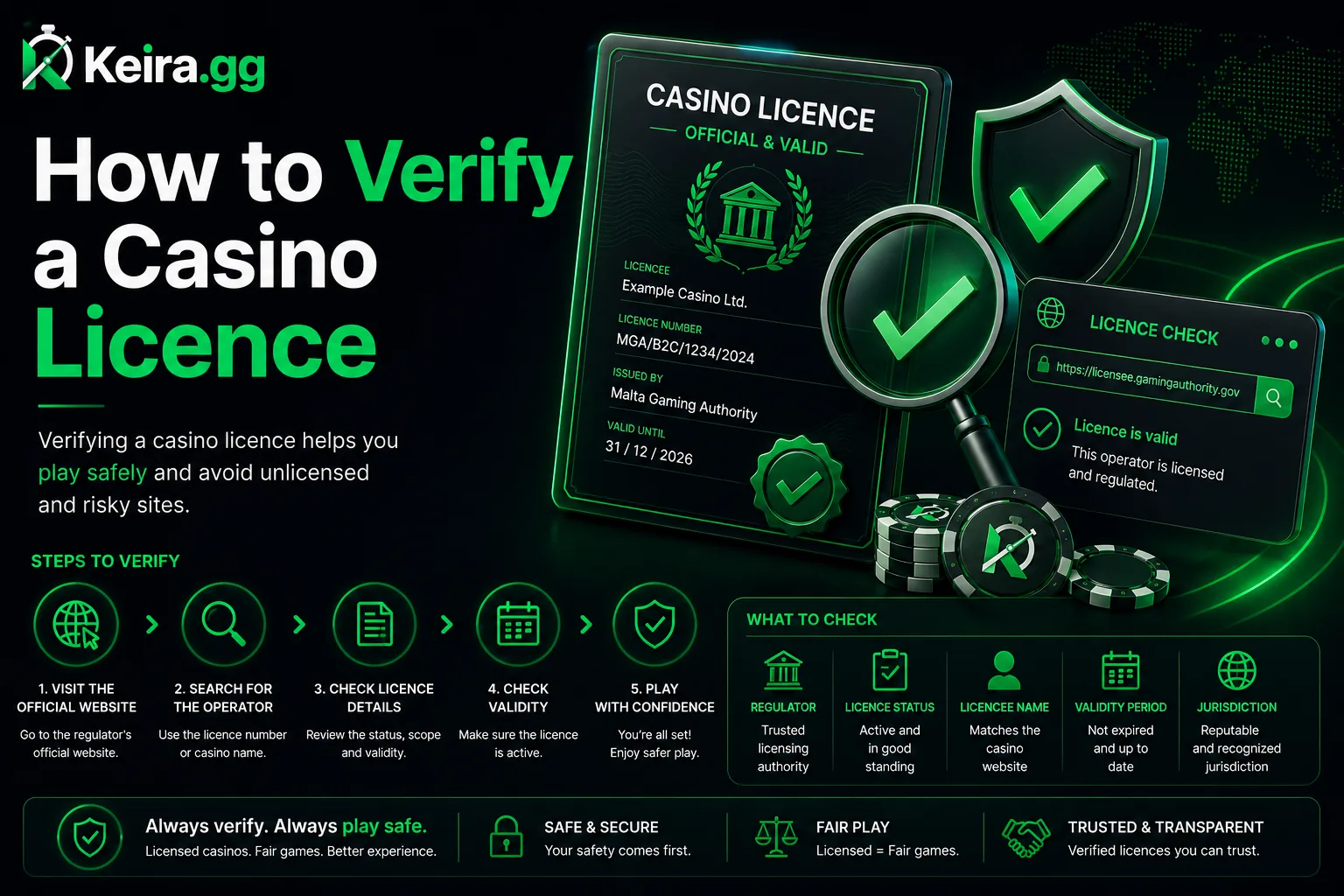
Why the badge is not the licence
A licence badge on a casino footer is an image. Images are trivial to copy. The licence itself is a public record held by the regulator, and every regulator worth caring about publishes a register you can search by operator name. When the register and the badge do not match, believe the register.
The 60-second check
Grab the operator name and the licence number from the footer, then open the regulator's own register in a new tab. Search the number, verify the name matches the company running the casino (the trading brand is often a subsidiary), and read the licence status. Active, revoked, suspended and expired all mean different things. Anything other than active means walk away.
Where each regulator publishes its register
| Regulator | Register lookup | What to check |
|---|---|---|
| UK Gambling Commission | Public register on the UKGC website | Operator name, licence number, "current" status, activities allowed |
| Malta Gaming Authority | Licence Register on the MGA site | Class of licence, active-since date, associated brands |
| Kahnawake Gaming Commission | Approved operators list | Operator, licence number, active or suspended |
| Curacao (GCB) | New master licence register (post-2023 reform) | Look for the direct GCB number, not sub-licences |
| Gibraltar Gambling Commission | Licensed operators list | Operator, licence type, jurisdiction |
| Isle of Man GSC | Public licensee list | Operator, licence class |
| Spain DGOJ | General operators register | Full brand, licence type, activities |
| Ontario iGaming | AGCO iGaming register | Registered operator, brand, status |
Five instant red flags
Any one of these should make you close the tab. A licence badge with no clickable link, or a link that goes to a static image. A licence number that returns zero results on the regulator's own register. A regulator register that does not exist as a searchable public list. A licence status of "revoked", "suspended" or "expired". A footer that names a regulator but does not display a number at all.
Offshore licences that are still worth something
Not every offshore licence is a paper tiger. Post-2023 the Curacao regime has a genuine central register; a direct GCB number is meaningful in a way an old sub-licence never was. Kahnawake and Anjouan can be legitimate depending on the operator. Isle of Man and Gibraltar are strict jurisdictions that publish full registers. Costa Rica, on the other hand, does not licence gambling at all; a "Costa Rican licence" is a company registration, not a regulator seal.
Six things to check on any licence page
A live, valid licence on the operator's footer is the first hurdle. A valid page proves a licence exists; it does not prove the operator behaves. Cross-check six items to move from "licence exists" to "licence is trustworthy."
- Licence number matches the regulator directory. Every listed regulator publishes a searchable public directory. Paste the number into the directory and confirm the operator name matches.
- The licence status shows active. Suspended, revoked or lapsed licences sometimes remain in operator footers weeks after the fact.
- The regulator jurisdiction covers your country. An MGA licence is meaningful in the EEA but does not authorise UK play; a UKGC licence does not cover Germany.
- The operating entity matches the site brand. Corporate-structure games occasionally hide behind a licensed shell.
- Complaint mechanism is signposted. Any licensed operator must publish the escalation path to the regulator's alternative dispute resolution body.
- KYC and responsible-gambling policies exist. These are mandatory for all real regulators and their absence is diagnostic.
A field guide to the major regulators
| Regulator | Jurisdiction | Trust weight | Verify at |
|---|---|---|---|
| UKGC (Gambling Commission) | United Kingdom | Very high | gamblingcommission.gov.uk |
| MGA (Malta Gaming Authority) | Malta, EEA | High | authorisations.mga.org.mt |
| Spelinspektionen | Sweden | Very high | spelinspektionen.se |
| Spillemyndigheden | Denmark | Very high | spillemyndigheden.dk |
| KSA | Netherlands | High | kansspelautoriteit.nl |
| ANJ | France | High | anj.fr |
| Gibraltar RGC | Gibraltar | Medium-high | gibraltar.gov.gi |
| Curaçao GCB | Curaçao | Medium (variable) | gamingcontrolboard.cw |
| Anjouan | Anjouan | Low (weak enforcement) | Public register limited |
Curaçao and other lower-tier licences deserve a special note
Curaçao licences are still common in the crypto-casino segment and are not automatically disqualifying. The regulator's 2023 reforms strengthened the framework, and post-reform Curaçao licences carry meaningfully more weight than pre-reform master-and-sublicence arrangements. What Curaçao licences do not offer is the kind of dispute resolution that UKGC or MGA licences do. If a payout goes wrong at a Curaçao-licensed operator, your practical recourse is limited.
Anjouan and similar low-tier licences add very little consumer protection. Their public directories are often unreachable, and enforcement track records are effectively non-existent.
Spotting fake or misrepresented licences
Fake licence logos are common on scam sites. The tell is that a logo is displayed without a linked, click-through verification. A genuine licensed operator will link the logo to the regulator's directory listing. If the click goes to the operator's own "about us" page, or nowhere at all, the licence is decorative rather than real.
Practical tools and where to look
Beyond the regulator directory, a small toolkit makes verification faster. WHOIS lookups reveal domain registration history that occasionally exposes a shell operator running a rebrand. AskGamblers, TheGamblerBay and Casino Guru maintain public complaint databases; a pattern of unresolved complaints alongside a valid licence is a warning sign that regulator intervention has been slow to bite.
Trustpilot and Reddit gambling communities also provide colour, though both need to be read with awareness of astroturfing. A pattern of similar complaints across independent sources is more informative than any single review.
If you play at an offshore or lightly-licensed operator
The choice to play at a Curaçao or Anjouan-licensed operator is legitimate; it just carries a specific set of trade-offs. You give up the strong dispute resolution of a UK or Malta licence, and you rely on the operator's own compliance culture and reputation. In that setting, the operator's track record on complaint volume, response time and cash-out speed matters more than the licence document.
The practical adjustment is smaller deposits, faster withdrawals and less balance kept with the operator over time. Treat the operator relationship as a rolling test rather than a long-term deposit account.
Red flags on an unlicensed or shell-licensed operator
A short list of patterns that are almost always diagnostic. If a site shows two or more of these, walk away regardless of what the licence page claims.
- Licence logo not clickable, or click leads nowhere useful.
- KYC promises only "if we suspect fraud" — a licensed operator has to do KYC by rule, not by suspicion.
- Withdrawal caps that are far below deposit limits.
- T&Cs allow the operator to void winnings at their discretion.
- No published complaint escalation path.
- Responsible-gambling page is copy-pasted from a template with no market-specific resources.
- Chat support cannot name the licensing regulator when asked.
The licence check is a first filter, not a guarantee
A valid, current licence tells you the operator has passed a specific regulatory bar and is subject to a dispute mechanism if things go wrong. It does not tell you that the operator has good customer service, fair bonus terms, or fast withdrawals. Combine the licence check with a look at the operator's public complaint history, and treat the two together as your minimum viable due diligence before depositing.
The one-minute verification workflow
Once the checks are learned, the verification takes about a minute. Open the casino footer, click the licence logo, land on the regulator directory, confirm operating entity name matches the site brand, note the licence status is "active" or "in force" and check the jurisdiction covers your country. If any of those five steps fails, close the tab. The tiny time investment is the single highest-return diligence step you can run before depositing money.
Book the workflow into muscle memory. Every casino you have not verified is a licence check away from either becoming a trusted option or being ruled out. Neither result is bad; both are cheap.
FAQ
Do I really need to check the licence before playing?
Yes, once, for any casino you plan to deposit at. The check takes a minute and it is the difference between a regulated site that has to pay you and an unregulated one that does not.
What if the licence check comes back inactive?
Do not deposit. If you already have a balance on the site, request a withdrawal immediately and, if it fails, file a complaint with the regulator that issued the last-known valid licence.
Are Curacao casinos safe?
Post-2023, a direct Curacao Gaming Control Board licence is genuine and enforceable. Older sub-licences under one of the four historical master licences are less so, and any "Costa Rica" claim is not a gambling licence at all.