

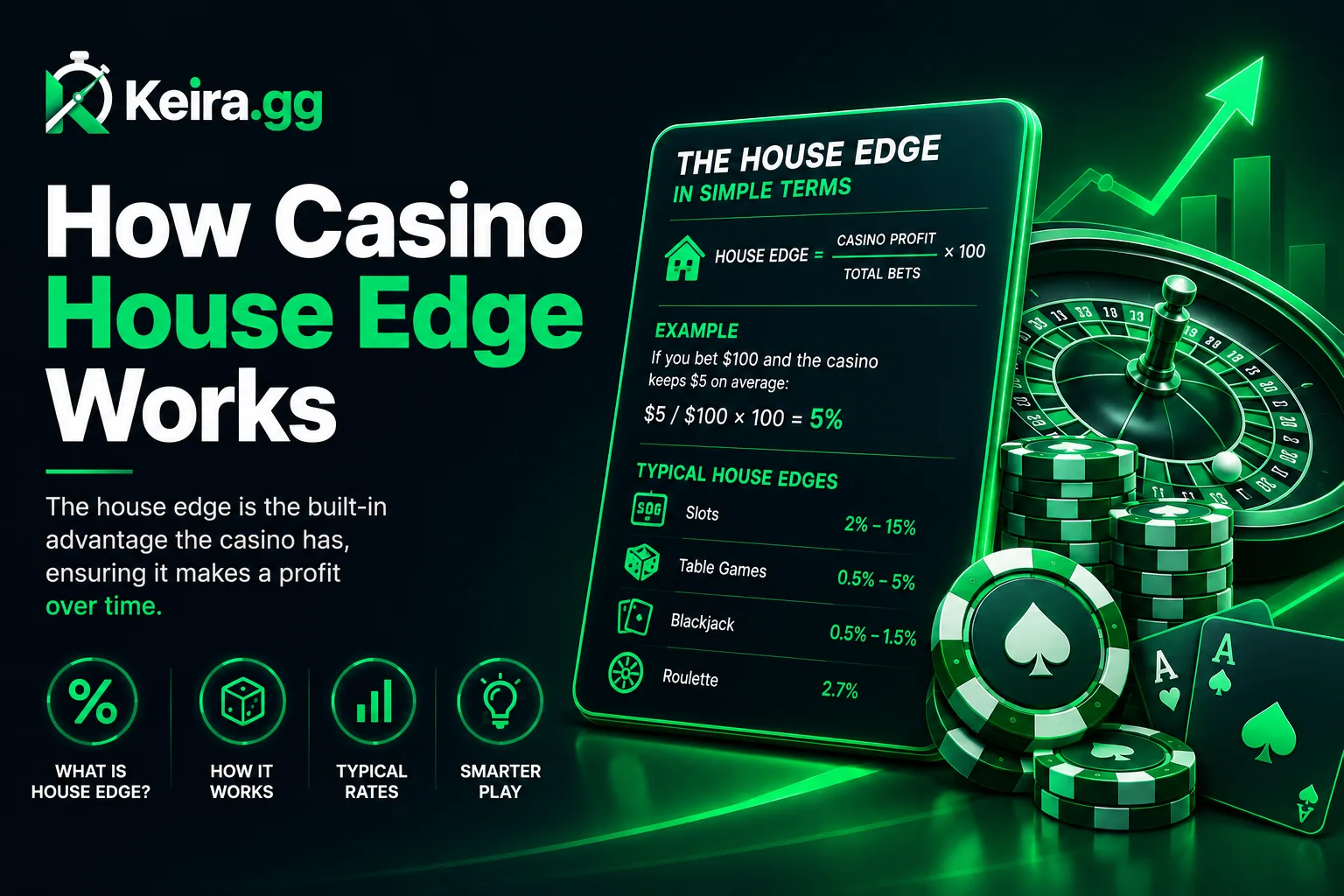
What house edge really means
House edge is the fraction of every stake the casino expects to keep over the long run. A game with a two per cent house edge means that, averaged across every hand or spin, the casino keeps two cents of every euro staked and returns ninety-eight. The player does not experience this in a single session, ever. It is the long-run price of playing.
RTP is the flip side of house edge
Return to player is 100 per cent minus the house edge. A slot with 96 per cent RTP has a four per cent house edge. RTP is the number displayed on most slot info pages because it is easier to sell "96 per cent back" than "four per cent lost". The two are the same maths from opposite ends.
Two important footnotes. RTP is a long-run average across millions of spins; a session of five hundred spins can be almost anywhere on the distribution. And RTP is set by the studio in a range (often 94 per cent, 95 per cent, 96 per cent and 97 per cent variants of the same slot) that operators can choose from. The same slot at two different casinos can have two different RTPs. Always check the info screen inside the game, not the marketing copy.
Edge by game, in one table
| Game | House edge | RTP | Notes |
|---|---|---|---|
| Blackjack (basic strategy, 3:2 rules) | 0.4% to 0.7% | 99.3% to 99.6% | Cheapest common game, if you play correctly |
| Baccarat (banker bet) | 1.06% | 98.94% | Player bet is 1.24%; tie bet is 14.4%, never take |
| Craps (pass line with 3-4-5x odds) | 0.4% | 99.6% | Only when odds are laid; base pass line alone is 1.4% |
| European roulette (single zero) | 2.7% | 97.3% | Every bet has the same edge except La Partage/En Prison, which halve it |
| American roulette (double zero) | 5.26% | 94.74% | Avoid unless the single-zero table is unavailable |
| Slots (typical online) | 3% to 8% | 92% to 97% | Wide range; check the game's info screen for the specific value |
| Live dealer game shows | 3% to 6% | 94% to 97% | Crazy Time and similar; entertaining and expensive |
| Keno / scratchcards | 10% to 30% | 70% to 90% | The most expensive lobby corner in the casino |
Variance: the reason your session feels random
Variance is how far individual sessions swing from the long-run average. A low-variance slot pays small wins frequently and rarely hands you a big score; a high-variance slot pays a lot of empty spins and occasionally a life-changing one. Both can have the same RTP and the same house edge. You just feel the price of the game very differently.
Bankroll needs to match variance. A 100 EUR bankroll on a high-variance slot with 200x maximum wins will vanish in fifteen minutes eight sessions out of ten and last three hours the other two. Same bankroll on a low-variance slot lasts an hour every time, with less drama at either end. Neither is cheaper; one is calmer.
Hit frequency and slot maths
Hit frequency is the percentage of spins that pay anything at all. Modern slots range from about twenty per cent (high variance, empty spins dominate) to close to fifty per cent (low variance, small returns often). A hit frequency of thirty per cent does not mean you are ahead; the average paying spin might be smaller than the average losing spin.
The other useful number the info page can tell you is maximum win multiplier. A slot capped at 500x your stake is a different beast from one capped at 25,000x. High-variance slots exist to sell the possibility of the cap. Nothing about the maths guarantees you will see it; the cap is rare by design.
What edge does to a 200 EUR bankroll
Say you sit down with 200 EUR at a 3 per cent house edge slot, 5 EUR spins, one spin every four seconds. Your expected loss per hour is 5 * 900 spins * 0.03 = 135 EUR. Not 3 EUR. Not 6 EUR. 135. That is the price of an hour on that slot at that stake, and it is the number that surprises most first-time players.
Two ways to make an hour of play cheaper without stopping the game: lower the stake or move to a lower-edge game. Blackjack at 5 EUR a hand at basic strategy, 60 hands an hour, 0.5 per cent edge costs 1.50 EUR per hour in expectation. That is the leverage the game selection has, before the first card is dealt.
RTP versus house edge: two ways of saying the same thing
You will see both metrics quoted in casino marketing. RTP (return-to-player) is the percentage of stakes returned to players over the long run; house edge is what stays with the operator. A 96% RTP slot has a 4% house edge, and the two numbers are just complements. Some regulators prefer one, some the other, but they carry identical information.
Where the two metrics can mislead is on the horizon. Both are long-run averages, meaning "over a very large number of spins the observed return converges to this figure." A single session can and often does deviate wildly. The 4% house edge is the reason casinos win over months, not the reason you lose on Friday night.
Variance is the metric most players ignore
Two slots with identical RTP can feel completely different because variance dictates the shape of the outcome distribution. High-variance slots pay big prizes rarely, low-variance slots pay small prizes often, and the expected value is the same either way. Bankroll requirements diverge sharply.
| Game class | Typical RTP | Variance | Session feel |
|---|---|---|---|
| Classic 3-reel slot | 95-97% | Low | Small wins often, few dry runs |
| Video slot with bonus rounds | 95-97% | Medium | Bonus round drives most of the return |
| Progressive jackpot slot | 85-93% | Very high | Long dry runs, jackpot-or-nothing |
| Blackjack (basic strategy) | 99.5% | Medium | Small edge decisions matter |
| Baccarat (banker) | 98.94% | Low | Slow bleed, few surprises |
| Crash / Aviator | 99% (typical) | Configurable via cash-out | Player controls variance |
Where the operator actually earns the edge
House edge is not a fee the operator charges on each round; it emerges from the rules of the game itself. A single-zero roulette wheel with 37 pockets pays even-money bets at 1:1, but only 18 of the 37 pockets are red. Do the arithmetic and the expected value per unit staked is −1/37, or −2.7%. That is the house edge, baked into the wheel geometry.
The upside of understanding this is that not all games are alike. Blackjack basic strategy holds the edge under 0.5%; European roulette runs at 2.7%; American double-zero roulette doubles that to 5.26%; a typical jackpot slot might sit at 6-8%. The choice of game matters more than any of the popular betting systems.
Betting systems are edge redistribution, not edge elimination
The Martingale doubles the stake after every loss so that a single win recovers all prior losses. It works right up until the losing streak is long enough to exhaust the bankroll or hit the table limit, and then it collapses catastrophically. All progressive betting systems share the same maths: they redistribute variance without changing expected value. If a game has a 2.7% edge, no sequence of stake sizes can change that number.
FAQ
What is the difference between RTP and house edge?
They are two ways of stating the same number. Return to player is what the game gives back on average; house edge is what it keeps. RTP plus house edge always sum to one hundred per cent.
Does higher RTP mean I will win?
No, it means you will lose more slowly on average. Even a 99 per cent RTP blackjack game has a 1 per cent expected loss per stake and a session can end at any point in the variance distribution.
Which slot has the best RTP?
Individual titles change; look for slots with published RTP above 96 per cent that are also the studio's high-RTP variant (some slots have 94, 95, 96 and 97 versions). Always check the info screen inside the game itself.
Is roulette better than slots?
European single-zero roulette has a lower house edge than most slots but higher than blackjack. American double-zero is a trap and worth avoiding when single-zero is available.