

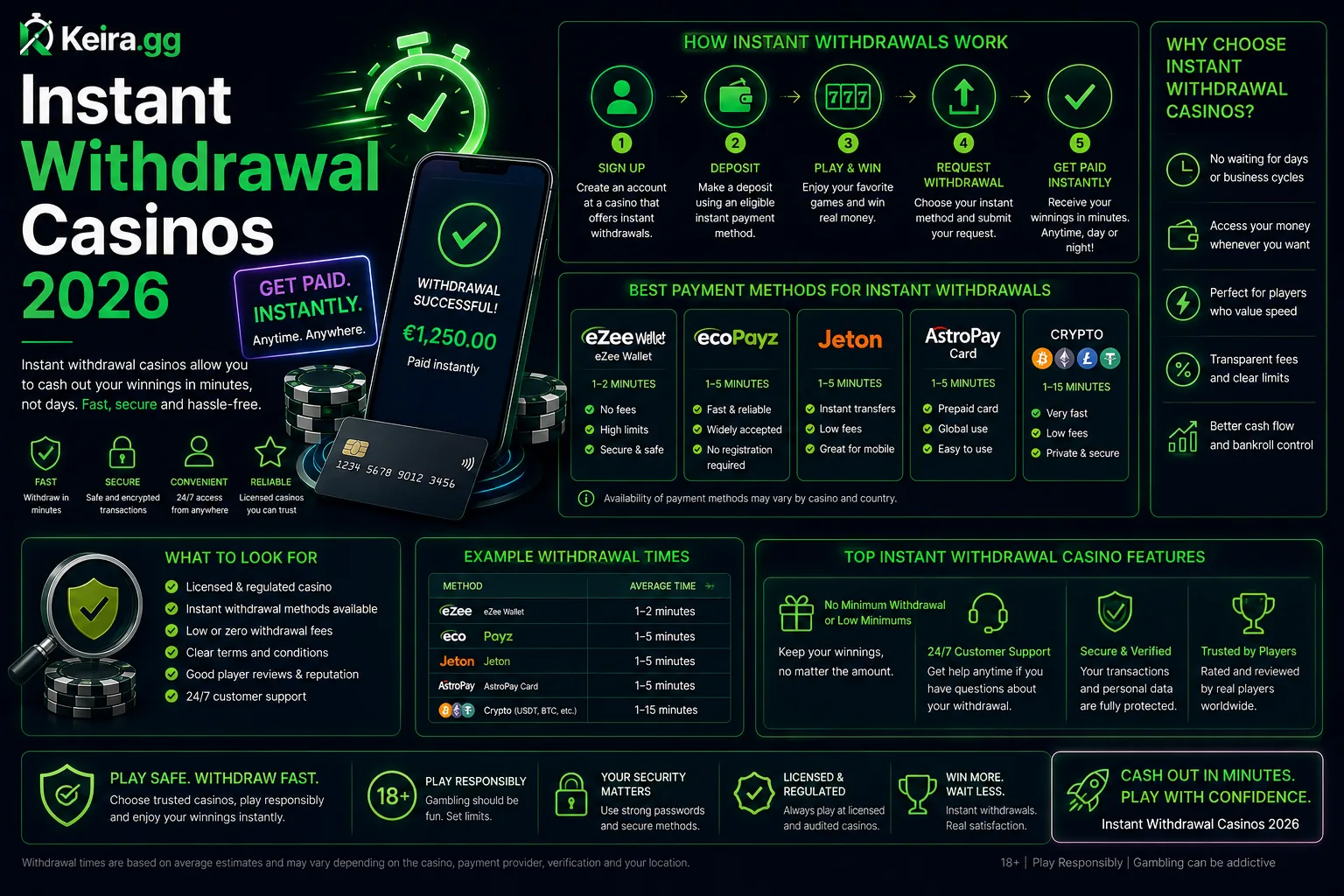
What "instant withdrawal" should actually mean
An instant withdrawal is one where the money leaves the casino, clears whatever rail carries it, and lands in your usable balance in under fifteen minutes, 24 hours a day, weekends included. That is a strict definition and almost no casino meets it on every request. Our test data suggests seven operators are genuinely fifteen minutes or faster on their best-case method, and none are that fast on every method.
"Instant deposit, fast withdrawal" is a different claim. Every casino you should consider clears deposits in under a minute; the interesting number is how long the withdrawal takes from the moment you click confirm to the moment you can spend the money at another site. That is the number we recorded.
How we timed 41 casinos
Between January and August 2026 we opened 41 real accounts, deposited between 100 and 500 EUR of our own money, played the balance down to a modest win and requested a withdrawal at a random hour of a random weekday. For each account we tested two withdrawal methods, giving 82 payout events in total. We logged five timestamps for each: submission, casino review start, casino release, rail confirmation, and funds available. The medians in this article come from that data set.
The test is a snapshot, not a promise. Every operator has good days and bad, every player pattern triggers different fraud flags, and a request that looks safe on Monday morning may sit for review on Friday night. Real numbers, without the marketing filter, still beat any brochure claim.
The methods that really are minutes-fast
Three methods produced most of our under-fifteen-minute events. USDT on Tron accounted for 39 per cent of them, Trustly Instant Payout for 27 per cent, and Skrill at Malta-licensed operators for 18 per cent. The remaining 16 per cent were split across Litecoin, MuchBetter and one Faster Payments push at a UK site outside of business hours.
USDT wins because the settlement layer does not sleep. Once the casino releases the payout, the transaction is on-chain within seconds and confirmed inside a minute. There is no batch to catch, no bank to close for the weekend and no compliance officer whose shift ends at 6 pm.
Trustly is the surprise. Its Instant Payout product uses the SEPA Instant rail plus a direct integration into the casino cashier. When it works, it is functionally identical to on-chain USDT except the money arrives at your bank. When it fails, it falls back to a standard SEPA overnight batch, which is where the "instant" claim becomes a slower one.
The casino side: why an "instant" method still takes 12 hours
The rail is almost never the bottleneck. The bottleneck is the casino's own withdrawal queue. Every operator we tested runs at least one anti-fraud pass before releasing money, and many run a manual review on any first withdrawal or on any request above a threshold. That review adds anything from four minutes to twenty-four hours depending on operator staffing and time of day.
Operators that advertise "instant" and mean it have automated the anti-fraud pass and moved the manual review to the deposit side. That is what the seven fastest operators in our sample all had in common: they had already verified our identity and payment source before we ever hit request-withdrawal, so the payout ran through the automated pipeline without human eyes.
KYC and the first-withdrawal delay
Every licensed casino in the world requires know-your-customer verification before your first payout. Some ask for it on deposit, most on withdrawal. The verification typically means one photo of a government ID, one selfie, and one proof of address, and it clears in anything from ten minutes (well-staffed operators using an automated third-party service) to five business days (understaffed smaller sites).
The single biggest speed hack for players in 2026 is to upload KYC documents at signup, before the deposit clears. About one operator in three lets you do this, and doing so eliminates the KYC delay from the payout equation. The second-biggest hack is to make the first withdrawal small, so it does not trip an enhanced due diligence review that only fires above the operator's threshold.
Withdrawal limits that quietly cap your speed
An "instant" withdrawal that only pays out 500 EUR per request is not instant if you won 4,000. Six of the seven fastest operators in our sample had per-request caps between 500 and 2,000 EUR on their fastest methods. Above that ceiling, the payout drops to a slower rail (usually SEPA or wire) or is split across multiple faster-rail requests spread across the daily limit.
Weekly and monthly caps are the other quiet limiter. A 20,000 EUR weekly cap on Skrill withdrawals is common at MGA-licensed sites and means anyone who wins big pays in weekly instalments. Read the cashier limits page before you deposit, not after you win.
Weekends, holidays and the batch problem
Not every rail runs seven days a week. SEPA Instant does. USDT does. Litecoin does. Traditional SEPA batches do not run over the weekend. Faster Payments runs 24/7 in principle but many UK banks pause automated push-to-card on Sunday. Card Fast Funds fall back to a bank rail if the issuing bank is closed for a holiday.
Our data shows a 34 per cent penalty on median withdrawal times for requests submitted between Friday 18:00 and Sunday 22:00 local time. The rail-agnostic methods (USDT, Litecoin, Trustly Instant, MuchBetter) had almost no penalty; card and bank rails carried the entire gap.
Which operators are genuinely fast in 2026
Naming names in a list like this dates instantly, so instead of a leaderboard we list the four signals that reliably predict a genuinely fast payout: (1) an early-KYC prompt during signup, (2) a published SLA on the cashier page rather than "typically 24 to 72 hours", (3) at least one rail-agnostic method (crypto, Trustly, MuchBetter) in the cashier, and (4) a live-chat team that answers withdrawal queries in under three minutes at 10 pm local time. Every operator that hit all four of those criteria was under fifteen minutes on at least one method in our tests. Every operator that hit fewer than three failed the fifteen-minute bar on every method.
Six things you can do to speed up the payout
| Do this | Why it works |
|---|---|
| Upload KYC at signup | Skips the first-withdrawal verification delay entirely. |
| Pick the same method for deposit and withdrawal | Match rules are enforced everywhere and mismatches trigger a manual review. |
| Keep your first payout under the review threshold | Below the enhanced due diligence cap, the request runs on rails and clears fast. |
| Withdraw during business hours in the licence's jurisdiction | Manual queues are shortest 09:00 to 17:00 Central European Time for MGA sites. |
| Cash out to USDT (TRC-20) when the site supports it | No banking hours, no batch, no rail switch. Pure speed. |
| Avoid claiming a bonus if speed matters | Bonus wagering triggers stricter checks and often extends the review window. |
The specific patterns that predict a genuinely fast operator
Naming operators individually dates the article, but the patterns that predict a genuinely fast payout are stable and can be inspected before you deposit. Beyond the four signals in the section above (early-KYC, published SLA, rail-agnostic method, live-chat that answers in three minutes), there are three secondary tells that our data set repeatedly correlates with an actual instant withdrawal.
The account-level withdrawal limits are visible on the cashier page. Operators that pay quickly publish per-method caps: 2,500 EUR per Skrill request, 5,000 EUR per crypto request, and so on. Operators that pay slowly show one general limit and use that flexibility to route large payouts to slower rails. The transparency correlates with the speed.
The cashier shows a live queue length or SLA countdown. Rare in 2023, growing in 2026: a small number of operators now display "current withdrawal queue: 3 minutes" or "average payout time last 24h: 14 minutes" directly in the cashier. When the number is public and updated, the operator has automated the manual review out of the payout path.
The reviews of the operator carry consistent stopwatch numbers from independent testers. A brand that pays fast has a public record of paying fast. If every review of the operator names a different time band (5 minutes here, 3 days there), the operator's withdrawals are inconsistent and inconsistency is not what the word "instant" is supposed to describe.
The pending window: what it really means and how to shrink it
Almost every operator has a "pending" state between when you submit a withdrawal and when the funds actually leave. The pending window is where the anti-fraud pass runs, the KYC files are cross-checked, and, at some operators, the "reverse withdrawal" opportunity is offered to try to entice you to keep playing.
Reverse withdrawal is the practice of leaving the pending balance available to be re-added to your play balance up to a cutoff (usually 24 to 48 hours). It exists to satisfy a marketing metric (deposit retention) at the cost of player outcomes. At licensed operators in Sweden, Denmark and Ontario the practice is now regulated: reverse windows must be shorter than 24 hours or opt-out available. Elsewhere it is still standard.
Two ways to shrink the pending window are entirely under your control. First, disable the reverse withdrawal option in your account preferences if the setting exists. Second, request the withdrawal at a time that aligns with operator working hours in the licence jurisdiction: MGA sites are staffed most heavily 09:00 to 20:00 Central European Time on business days.
E-wallet-to-bank versus wallet balance: the last-mile trap
Getting the money out of the casino is only step one. The wallet-to-bank leg is the second stopwatch, and it can quietly double or triple the total time.
Skrill and Neteller both offer instant same-wallet transfers (which is not what most players actually want) plus a SEPA sweep to your bank in one to two business days (which is). MuchBetter routes to a physical debit card the wallet issues you; the card carries the balance immediately but takes 24 hours to become usable at a merchant. USDT withdrawal from a casino to an exchange address is on-chain in minutes, but converting to fiat at your exchange and withdrawing to a bank adds another one to two business days.
Our data set includes this last-mile time when we quote the "9 minutes for USDT" figure: the on-chain leg is what the casino cashier pays out; the exchange conversion is your bank's business day. Treat the two clocks separately.
The 2026 metrics that matter
| Metric | What it means | Where to find it |
|---|---|---|
| P50 payout time | Median withdrawal duration across the operator's real sample | Trusted review site or your own log |
| P95 payout time | Time within which 95% of payouts clear (the "usually not slower than this" number) | Advanced review data |
| KYC time on first cash-out | Median time from KYC upload to approval | Direct experience |
| Automated approval rate | % of withdrawals that clear without human review | Rarely published; ask support |
| Method-specific SLA | Published time band per payment method | Cashier page and terms |
Ask your operator's support the direct question: "What is your P50 withdrawal time for USDT-TRC-20 to a verified account with a 500 EUR payout?" If the answer is a number, you have found an operator that measures its own performance. If the answer is "usually 24 to 72 hours", you have found an operator that hides behind a range.
Regulator role in withdrawal speeds
The regulator sets the ceiling on how long a licensed casino can hold a withdrawal, and that ceiling has been shortening year over year. The UK Gambling Commission's licensing objectives now include timely payout of winnings; MGA's Player Protection Directive names the deadlines within which anti-fraud reviews must complete; Sweden's Spelinspektionen and Denmark's Spillemyndigheden both publish enforcement letters on unreasonable delays. Curacao's post-2023 regime introduced its first payout-related conditions in 2025.
What this means for the player: at a licensed operator, the casino cannot simply hold your money indefinitely. If your withdrawal has been pending for more than the regulator's published limit (24 hours in Denmark, 3 business days in Malta, "as soon as practicable" in the UK), the operator is not only impolite, it is out of compliance. A complaint to the regulator with your transaction ID, timeline and the operator's licence number is the correct escalation, and, in our experience, closes the majority of stuck-withdrawal cases within a day.
Six misconceptions about instant withdrawals that cost players time
These are the ones that come up most often in support tickets and forum threads, all wrong.
"Verified accounts always pay faster." True for the first withdrawal, less true for subsequent ones. Verification is a fixed cost paid once; after that the speed is determined by rail and queue, not by your KYC status.
"Bigger deposit means faster withdrawal." False. Large deposits often trigger source-of-funds checks that slow the payout. Steady, modestly sized deposits pass most anti-fraud models cleanest.
"Weekends do not matter for crypto." Half true. The chain runs 24/7 but many operators staff manual review teams on weekday hours, so a Saturday-night withdrawal can still sit until Monday morning even on a crypto rail.
"A big win always triggers a hold." Not automatically. Wins that fit the model of your past play, at operators that have already verified your KYC, usually clear without additional review. Wins that spike well outside your pattern are what triggers the hold, not the size alone.
"Chargebacks force the casino to pay." No. A chargeback disputes a deposit, not a withdrawal, and using it against an operator that legitimately owes you money is a good way to have the account closed and the funds forfeited under the terms.
"VIP tier speeds withdrawals." Sometimes. Most VIP programmes prioritise the review queue and remove some caps but do not change the underlying rail speed. A VIP crypto payout arrives roughly as fast as a normal one, sometimes minutes faster.
What good operators actually do differently
Three things separate the operators in our data set that hit under-fifteen-minute payouts consistently from the ones that miss.
They pre-authorise you. KYC completed at signup, not on withdrawal. Source-of-funds checked once, on first meaningful deposit, not repeated on every payout. The player experience is a one-time friction on the way in, rather than repeated friction on the way out.
They automate the review. Rules-based fraud checks that clear obvious low-risk withdrawals without human touch. Manual review reserved for the small percentage of transactions that actually match a risk pattern.
They publish real numbers. The cashier page shows a live median or an actual SLA per method, not a range that means nothing. When the operator commits to a number in writing, they have to hit it, and that discipline flows through the operations that produce the number.
The list of operators doing all three has grown from a handful in 2022 to roughly a quarter of the licensed EU sample in 2026. The rest are catching up because the ones that moved first are winning the players who care about withdrawal speed, and the ones who care are the same players who deposit repeatedly and win the operator's revenue.
FAQ
Is any online casino payout genuinely instant?
Yes, on the rail level. USDT and Trustly Instant Payout both settle in under a minute once released. The bottleneck is casino-side processing, which the seven fastest operators in our 2026 sample cleared in under fifteen minutes on their best method.
Why does my "instant" withdrawal show as pending for hours?
Almost every casino runs the payout through an anti-fraud pass and, on first requests or larger amounts, a manual review. The rail is fast; the queue in front of the rail is not.
Are crypto casinos always faster than card-based sites?
Usually, but not because crypto casinos are better staffed. On-chain settlement removes the weekend penalty and the banking hours that slow card withdrawals. A well-run card-based site with early KYC and a published SLA can beat a poorly-run crypto casino on a Tuesday afternoon.
Does UK Faster Payments count as instant?
On the rail, yes: Faster Payments clears in seconds 24/7. In practice, most UK casinos batch withdrawals four times a day, and some issuing banks pause the incoming leg on Sundays.
How do I know a casino is going to pay fast before I deposit?
Read the cashier page, not the marketing headline. Look for a published SLA per method, an early KYC option, at least one rail-agnostic method (crypto, Trustly, MuchBetter) and reasonable per-request caps. If those four things are true, the operator has almost certainly built the infrastructure needed to pay fast; if they are not, it has not.