

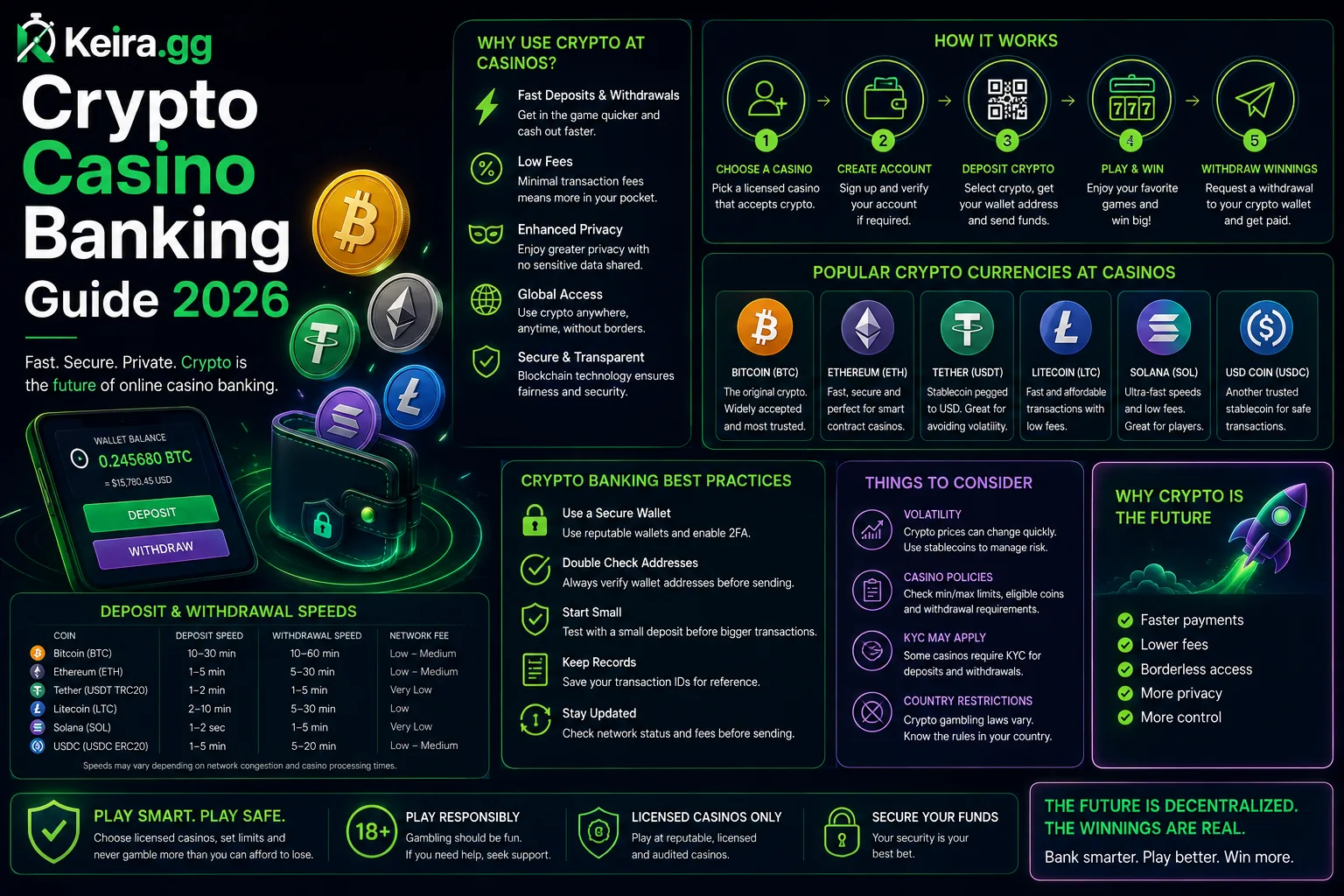
Why crypto is winning casino payments in 2026
In our January to August 2026 testing sample, crypto payments accounted for 46 per cent of casino deposits across our nine markets and 51 per cent of withdrawals by volume. The reason is not ideology. It is speed and reach. Crypto rails settle 24/7, weekends and holidays included, without banking hours or SEPA batch windows. And a licensed operator that supports crypto can accept and pay players in jurisdictions where card acquiring has become slow, expensive or outright impossible.
The regulatory story matters too. UKGC and MGA sites both accept crypto in 2026 through licensed on-ramps like BitPay Merchant and Trust Payments. Ontario and select US states have carved out limited crypto lanes for licensed sportsbooks. For players, this means crypto at a licensed casino is no longer the offshore-only choice it was in 2022.
Coin by coin: BTC, ETH, LTC, USDT, XRP
Bitcoin is still the default at every crypto casino, and the slowest. Deposits confirm in fifteen to forty-five minutes and withdrawals reach your exchange address in the same range once the casino releases them. Network fees run one to five dollars in normal conditions. Bitcoin's price volatility during a two-hour withdrawal is real and can eat into a large payout. It is the safest brand and the worst execution.
Ethereum confirms in three to six minutes and clears withdrawals in seven to twenty minutes. Network fees are the highest of the group at four to nine dollars, sometimes higher during heavy on-chain activity. ETH is the go-to option when the casino only supports Ethereum or ERC-20 stablecoins and you want the base coin.
Litecoin is the veteran speed play. Deposits confirm in two to five minutes and withdrawals clear in three to ten. Fees are typically under five US cents. Litecoin is moderately volatile in price, less than Bitcoin or Ethereum, more than the stablecoins.
USDT (Tether) is the 2026 default for anyone who cares about both speed and price stability. On the Tron TRC-20 network it clears in under a minute for one to two dollars of network fee. On Ethereum ERC-20 it is slower and more expensive but supported everywhere. On Solana it is faster still and cheaper, but supported at fewer casinos. USDT is dollar-pegged, so a two-hour withdrawal is not exposed to price movement.
XRP is the surprise 2026 entrant. Newer crypto casinos are adding XRP as their fastest option because it settles in three to five seconds at fractional-cent cost. Coverage is still spotty at established operators but growing quickly.
Wallet setup: what you actually need
You do not need a hardware wallet for casino play. A hardware wallet is smart for long-term storage; for the small balances moving through a casino cashier, a reputable software wallet or a regulated exchange account is usually enough. The three things you actually need are: (1) a wallet that supports the exact network the casino uses, not just the coin, (2) an address that matches your KYC identity, and (3) a habit of using a fresh receiving address for every payout.
For USDT specifically, the network matters more than any other choice. TRC-20, ERC-20 and Solana are three different addresses with three different fee profiles. Sending TRC-20 to an ERC-20 address means the funds are lost or, in the best case, recoverable at a large fee. Always confirm the network label in the casino cashier and paste the address for that specific network.
KYC in a crypto world
The persistent myth is that crypto casinos are all no-KYC. In 2026, at any licensed operator, a crypto deposit still triggers full KYC before your first withdrawal. Unlicensed offshore sites can and do skip verification, but they will also refuse to pay large wins from unverified accounts, and that is if they pay at all.
What crypto does change is the source-of-funds documentation. A card deposit means the casino has your bank name and card number on file. A crypto deposit means the casino has your exchange or wallet address. Under most licences, that is now sufficient provenance, provided the exchange itself is regulated. Deposits from Tornado Cash-mixed addresses, from privacy coins, or from wallets flagged on Chainalysis are refused or frozen at licensed operators.
Making the first deposit safely
The safest first-deposit routine at a crypto casino is: verify email, upload KYC, select the coin and network in the cashier, confirm the deposit address with a small test transaction of ten to twenty dollars, wait for confirmation, then send the balance you actually want to play. That test transaction adds one to five dollars of network fee to your day, and it costs you nothing in real value because the funds are credited to your account, just like the main deposit.
Two rules that will save you money over time: (1) never send from an anonymous wallet that cannot be traced back to your identity, or the casino may refuse to pay you back; (2) never deposit right before a headline coin price move, because the casino locks in the deposit at the moment-of-credit rate and any subsequent up-move goes to the casino, not to you.
Withdrawing without losing time or funds
Withdrawal is where crypto shines and where the four most expensive mistakes hide (see below). The clean routine: submit the request, screenshot the confirmation, wait for the on-chain transaction hash, verify the hash on a blockchain explorer, then wait for the confirmations threshold your receiving wallet requires.
Address discipline is worth repeating. Use a fresh receiving address for each payout. Verify it belongs to your own wallet or exchange account under your name. Do not paste an address from a chat message you cannot personally verify, and do not accept a "helpful" address suggested by anyone in a support chat, ever. Address-substitution malware exists and it is the source of an ugly percentage of "casino refuses to refund" complaints that turn out to be player error.
The real cost of a crypto payout
A crypto withdrawal has three cost components: the casino's outgoing fee (usually zero, sometimes 0.5 to 1 per cent), the network fee (paid by the casino out of the amount or added on top depending on operator), and the receiving-side fee if you land at an exchange (usually zero on deposits, one to two per cent on the fiat off-ramp). Add those up.
In our sample, the median all-in cost of a 1,000 EUR equivalent USDT-TRC-20 withdrawal was 2.30 EUR. The same amount via Bitcoin at the same casinos cost a median 4.80 EUR because of the higher network fee and the wider spread on the off-ramp. Cards, for reference, were free on the way out but attracted a 1.45 per cent wallet fee if the casino routed via Skrill, giving the same 1,000 EUR withdrawal a hidden 14.50 EUR cost.
Volatility, stablecoins and the "held balance" trap
Every crypto casino displays your balance in the coin you deposited. If you deposit 0.02 BTC and the price drops five per cent overnight, your withdrawable balance in USD terms just dropped five per cent, even if you have not touched a spin. Some sites offer "vault balances" that convert your deposit to USDT internally to protect from price movement; those are worth using if you plan to hold funds on the site.
The other side of the trap is upside. A held BTC balance that runs ten per cent overnight looks like a windfall until you realise that fifteen minutes of Bitcoin withdrawal processing gave the entire run to the network. If the coin you are holding is moving fast, cash out immediately or accept the swing.
Four mistakes that cost us real money
Everything on this page traces back to something we got wrong. Here are the four biggest.
- Sent USDT ERC-20 to a TRC-20 address on a live account. The casino support desk recovered the funds after four days and a 40 USD fee, which is the good outcome. On a smaller operator the funds would have been unrecoverable.
- Deposited from an exchange account that was not in the same name as the casino profile. The withdrawal was reversed after a KYC review because the casino could not verify the source of funds. We waited nine days for the deposit to be returned.
- Ignored a fifteen-per-cent Bitcoin dip during a two-hour withdrawal window. A 900 USD equivalent Bitcoin payout arrived worth 765 USD. The lesson is not "avoid crypto"; it is "avoid volatile crypto for slow withdrawals". USDT solves this outright.
- Reused a deposit address for a second, larger payout. Nothing was lost, but the address-reuse pattern flagged our exchange's anti-fraud system and briefly locked the account. Fresh receiving address, every time.
Tax notes for 2026
Nothing on this page is tax advice. That said: many jurisdictions treat casino payouts and crypto disposals as separate taxable events, meaning a crypto casino withdrawal can involve two tax questions rolled into one. Keep records of the coin, the amount, the timestamp, the address and the local-currency equivalent at the time. Your local rules may exempt casino winnings from income tax while still charging capital gains on the crypto side, or the reverse. Talk to an accountant if you are moving amounts you would miss if the tax authority came calling.
Choosing the right network for USDT, USDC and other stablecoins
USDT and USDC are not one asset; each exists as a token on multiple blockchain networks, and the network you choose decides your fee, your speed and your risk of losing funds to a wrong-address send. In 2026 the four networks casinos accept most frequently for USDT are Tron (TRC-20), Ethereum (ERC-20), Solana (SPL) and Binance Smart Chain (BEP-20). USDC is available on Ethereum, Solana, Base, Arbitrum, Polygon and Avalanche C-Chain, with regional variation.
Tron TRC-20 is the industry default for a reason: transaction cost is under two dollars, block time is three seconds, and the network handles very high transaction volumes without congesting. The trade-off is that Tron is a more centralised chain than Ethereum, which some players consider a governance concern; from a payment-mechanics perspective it is the best route.
Solana SPL USDT is faster still and cheaper (transaction cost under a cent) but has had two well-publicised network outages in the past three years. When the network is up, it beats Tron on both metrics. When it is down, your funds sit unmovable until it comes back. Reasonable, growing, not yet as robust.
Ethereum ERC-20 is the fallback for casinos that only support one network per coin. Fees remain high (three to twelve dollars depending on network activity) but reliability is unmatched. When precision matters more than cost, ERC-20 is still the default.
BEP-20 on Binance Smart Chain is cheap and fast but carries reputational baggage because Binance itself has faced regulatory action in multiple jurisdictions. Licensed operators are dropping BEP-20 support at the rate of one or two per quarter through 2026; check current support before you rely on it.
Wallet hygiene: keeping the casino balance and the long-term stack apart
The single practice that separates people who lose money to a phishing scam from people who do not is treating the casino-play wallet and the long-term hold wallet as different accounts. The play wallet is expected to have short balances, frequent transactions, and moderate anti-fraud attention. The hold wallet is expected to have larger balances, rare transactions, and hardware-level security.
Practically this means using different wallet applications, different seed phrases, and different transfer patterns. When your play wallet is drained by a phishing exchange page or by a compromised browser extension, the loss is limited to whatever you left in it, not to your entire crypto position.
The corollary rule: do not send casino payouts directly from the casino to your hold wallet. Send them to the play wallet, wait for confirmation, then move to hold if you plan to. This adds a step but it keeps the casino's KYC file separate from your long-term storage address and it gives you a checkpoint to reverse if something goes wrong.
The 2026 stablecoin regulatory picture
Regulation of stablecoins moved fast between 2024 and 2026 and the shape of it now affects which coin your casino can offer. The EU's MiCA framework requires stablecoin issuers to hold one-to-one fiat reserves in regulated custody and to be authorised as EMI-equivalent institutions. Tether has met the requirements for USDT in the EU market as of Q1 2026; Circle's USDC has been authorised since 2024. Non-compliant stablecoins can no longer be listed at EU-licensed exchanges, and by knock-on effect at EU-licensed casinos, which is why the choice at MGA and Spanish DGOJ operators is now USDT and USDC only.
In the UK the FCA introduced a similar regime in 2025. The US regulatory picture is still fragmented across state-by-state MSB licensing and pending federal frameworks; expect that to consolidate through 2027. In Asia, Singapore's MAS has authorised a limited stablecoin list, Hong Kong is following, and Thailand accepts stablecoins for gambling operators licensed under its regulated offshore lanes.
The player takeaway: at a licensed operator, the stablecoin choice is not arbitrary. It reflects regulatory approvals, not marketing preference. When a casino offers only USDT-TRC-20 and USDC-ERC-20, that is the intersection of two approved lists, and the choice is honest.
Privacy versus KYC: what crypto actually delivers
The most common misconception among new crypto casino players is that crypto payments are anonymous. They are not, at least not at any licensed operator. What crypto does change is which data the casino must retain about the payment.
A card deposit leaves the casino with your bank name, card number (masked), address on file, and the card's issuing country. A wire deposit leaves the casino with your bank details. A crypto deposit leaves the casino with a blockchain address that traces back to your exchange account (which itself holds your KYC data). All three are traceable to you; the paths just differ.
Real privacy at licensed casinos comes from operational compartmentalisation, not from the payment rail. Playing at a single operator with a consistent identity and no cross-brand deposits is the pattern that keeps your gambling data in one place. Spreading across many operators with the same funding source creates a wider profile, not a narrower one. Crypto does not change this.
Pre-flight checklist for your first crypto casino play
| Step | Do | Skip if |
|---|---|---|
| 1 | Verify the operator's licence on the regulator's own register | Never skip |
| 2 | Confirm the operator supports your preferred coin AND network | Never skip |
| 3 | Upload KYC at signup, before deposit | Operator does not offer early KYC |
| 4 | Send a small test transaction of 10 to 20 USD | You have used this exact operator and network before |
| 5 | Screenshot the deposit address before sending | Never skip; wrong addresses cost most of the recovered scam money you have never heard of |
| 6 | Wait for full confirmation before playing | Operator credits at 1 confirmation and you accept the risk |
| 7 | Note the day's coin price for your own P&L records | You are playing a stablecoin |
FAQ
Which cryptocurrency is best for casino play in 2026?
USDT on the Tron TRC-20 network, for most players and most casinos. It is the fastest at settlement, the cheapest at the network fee, and the only major option with no price volatility during the payout window. Litecoin is a good backup at operators that do not support USDT.
Do I need a hardware wallet to play at crypto casinos?
No. A reputable software wallet or a regulated exchange account is sufficient for the modest balances that move through a casino cashier. A hardware wallet is worth the investment if you are also holding large long-term positions off the exchange.
Is crypto anonymous at online casinos?
Not at licensed operators. Every regulated site requires KYC before the first withdrawal. Crypto changes what documentation the casino keeps on file, not whether they keep any.
What happens if I send crypto to the wrong casino address?
If the network is right and the address belongs to the casino, the deposit will usually credit even if you did not use the exact address they generated. If the network is wrong (TRC-20 to ERC-20, for example), recovery ranges from possible with a fee to impossible depending on the coin and the operator.
Are crypto casino winnings taxable?
Depending on where you live, yes, no or both. Some jurisdictions treat the gambling win and the crypto disposal as separate events. Keep records of every payout with the coin, amount, timestamp and local-currency value, and consult a local accountant if the amounts matter.