

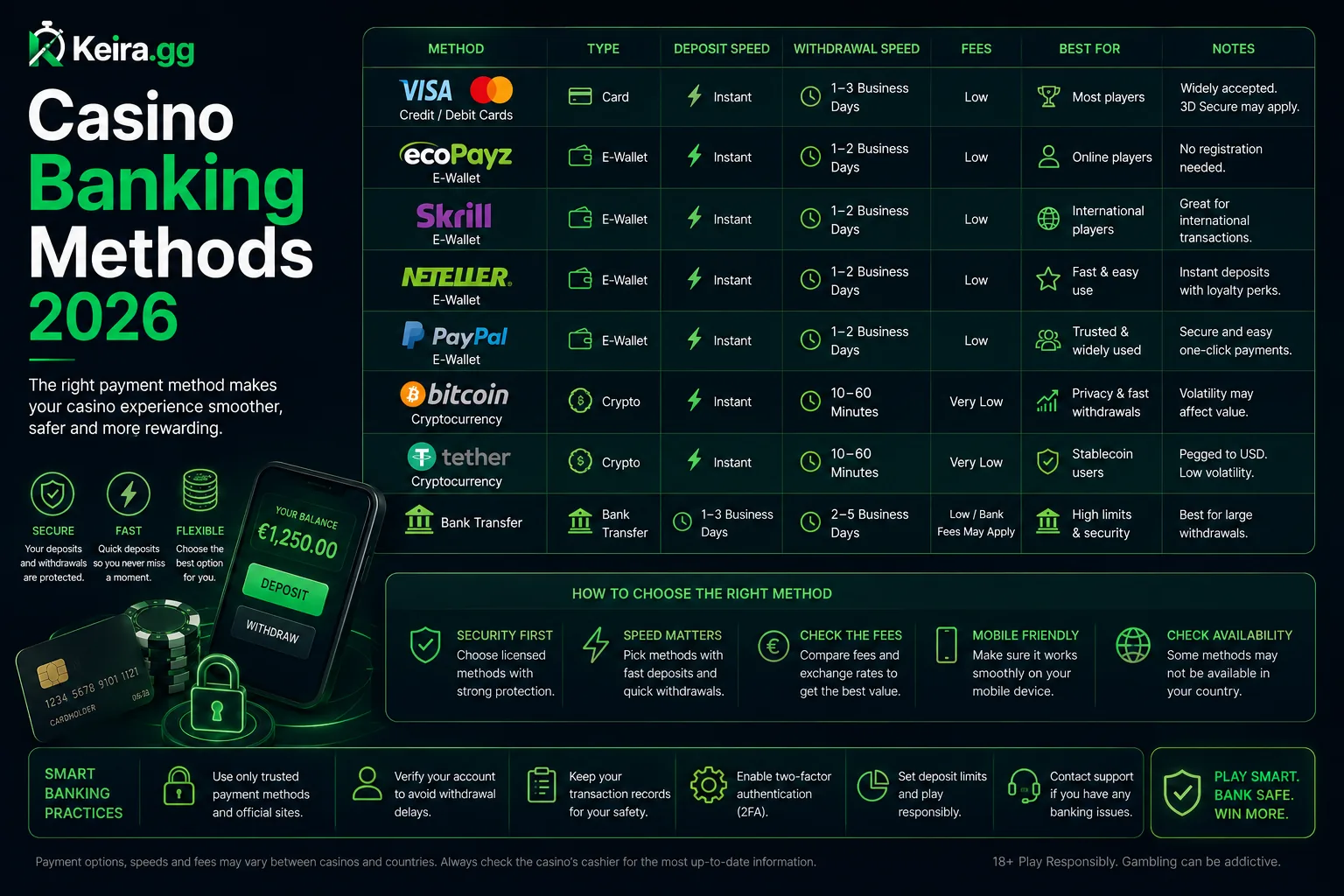
The 30-second answer
Speed matters more than the method label. In our 2026 testing, the four fastest routes to money in your account were, in order, on-chain USDT (median 9 minutes end-to-end), Trustly Instant Payout at licensed European operators (11 minutes), Skrill at licensed European operators (46 minutes), and MuchBetter (1 hour 12 minutes). The four slowest were traditional bank wire (median 3.4 business days), Visa withdrawal via Fast Funds (28 hours), Neosurf voucher refund (48 hours) and Paysafecard mastercard-branded refund (up to five business days).
The unavoidable rules for 2026 have not moved: your withdrawal method usually has to match your deposit method, KYC has to be completed before the first withdrawal at any regulated site, and every casino has a right to hold a payment for anti-fraud review if the amount is large or the pattern is unusual. Every number below is a median, not a promise.
E-wallets: Skrill, Neteller, MuchBetter, Jeton
E-wallets are the workhorse of online casino payments. The wallet holds your card or bank details in one place, and the casino only ever sees the wallet address, which means the operator has less data on you and you have one dashboard for all your gambling deposits.
Skrill remains the market leader inside the EEA, the UK and the Nordics. Deposits are instant at every regulated casino we tested. Withdrawals in our sample cleared to the Skrill balance in a median of 46 minutes once the casino released them. That is a big once: most casinos hold the request for one to twenty-four hours of "review" before pushing it. From Skrill to your bank takes another zero to two business days for a SEPA sweep, or minutes for a Skrill-to-Skrill transfer.
Neteller, owned by the same group as Skrill, behaves nearly identically at licensed EEA sites. It has slightly better coverage in Canada and Latin America but slightly worse UK coverage after the 2025 processor consolidation. Fees are the same tier as Skrill.
MuchBetter is a UK-friendly mobile-first wallet with strong casino support. Median withdrawal time in our tests: 72 minutes. Its "cash out to card" feature routes to a physical debit card issued by the wallet, which is convenient but adds a 24-hour settlement window if you actually want the money at your bank.
Jeton and ecoPayz (now PayzOne) are the go-to fallbacks when Skrill or Neteller are blocked in your region. Speed is comparable, fees are a touch higher, and reversal handling is less generous.
Every major e-wallet still bans a portion of its own users from claiming casino welcome bonuses. Read the terms page before you deposit or you will lose the bonus and, in the worst case, the winnings that came from it. In practice the rule shows up on Skrill and Neteller deposits at UKGC and MGA sites; NZ and Ontario are usually exempt.
Cards: Visa, Mastercard and the 3-D Secure delay
Debit and credit cards remain the default deposit method for most casual players. In 2026, a Visa or Mastercard deposit clears in three to eight seconds at every major operator we tested, provided your bank does not decline the merchant code. In the UK, gambling deposits on credit cards remain banned; that ban has not been rolled back and any UK-licensed site that appears to accept credit has almost certainly routed the payment through a debit rail.
Withdrawals via card use Visa Direct or Mastercard Send, marketed as "Fast Funds" or "Cash Send". These are near-instant on the rails, but almost no casino processes them in real time. In our data, a card withdrawal took a median of 28 hours end-to-end. About one in six card withdrawals in our sample fell back to a bank transfer because the issuing bank did not support the push-to-card capability. When that happens, add another one to three business days for a SEPA or Faster Payments transfer.
The other card gotcha is the 3-D Secure step-up. Some banks, particularly in Germany, France and Ireland, will hard-decline the second or third gambling merchant of the day on a single card. Split the deposits over methods to avoid the block, or switch to open banking (see below).
Crypto: BTC, ETH, LTC, USDT compared
Crypto is the single biggest speed advantage a casino can offer in 2026, and the choice of coin matters more than which casino you use. Our test data:
| Coin | Deposit confirms in | Withdrawal to your wallet | Network fee we paid | Volatility risk |
|---|---|---|---|---|
| USDT (Tron TRC-20) | ~1 minute | 2 to 9 minutes | $1 to $2 | None (dollar-pegged) |
| USDT (Ethereum ERC-20) | 2 to 4 minutes | 5 to 15 minutes | $3 to $12 | None (dollar-pegged) |
| Litecoin | 2 to 5 minutes | 3 to 10 minutes | Under $0.05 | Moderate |
| Ethereum | 3 to 6 minutes | 7 to 20 minutes | $4 to $9 | Moderate |
| Bitcoin | 15 to 45 minutes | 25 minutes to 2 hours | $1 to $5 | Highest |
For pure speed, USDT on the Tron network is unbeatable. For lowest fees, Litecoin still wins on small transactions. For safety of held balance during withdrawal, USDT beats every volatile coin, because a two-hour Bitcoin cash-out that drops five per cent in that window is a net loss.
The catch with crypto is address discipline. Every casino in our test sample refuses to send funds to any wallet address that does not match your KYC identity, which usually means a fresh receiving address generated by an exchange that matches your name on file. Send from a wallet the casino cannot verify and expect the withdrawal to be reversed within 48 hours.
Bank transfer: SEPA, Faster Payments, Wire
Bank transfer is the slowest common route in every direction, but it is also the cheapest and highest-limit path. If you are moving five figures or more, wire remains the only method that most casinos will authorise without a compliance escalation.
Within the Eurozone, SEPA Instant is now supported by almost every licensed operator. Deposit clears in under a minute, withdrawal clears in one to three business days. UK Faster Payments works similarly for deposits (instant to twenty minutes) and clears withdrawals within one business day at the top-tier operators. US and international SWIFT wires remain the two- to five-business-day option, with a $10 to $35 sending fee and often a receiving-bank charge on top.
Prepaid: Paysafecard, Neosurf, AstroPay
Prepaid vouchers are one-way instruments almost everywhere. You buy a voucher at a shop or online, punch the code into the casino cashier, and the deposit clears instantly. But most operators cannot pay a withdrawal back to a Paysafecard, so refunds go by bank transfer or, on some UK sites, to a linked debit card. Neosurf refunds route via bank in 90 per cent of cases.
Where prepaid does shine is anonymity of the deposit. If your bank statement is a sensitive document, a voucher purchased with cash keeps the deposit off it. Just remember that the casino will still require KYC before letting the money out.
Open banking: Trustly, iDEAL, Pay by Bank
Open banking is the sleeper category of 2026. Trustly Instant Payout and Pay by Bank route the payment directly from your bank to the casino using PSD2 rails. Deposits are instant. Withdrawals, when the casino participates in Trustly Payout Direct, clear in under fifteen minutes 24/7, including weekends. In our Swedish and Estonian testing, Trustly beat every wallet and matched Litecoin on speed. In the UK, Pay by Bank is now offered at most licensed operators, though withdrawals are slower than Trustly (typically same business day rather than same hour). In the Netherlands, iDEAL is instant on deposit but refunds via SEPA overnight batches.
Fees you actually pay in 2026
Casino deposit fees are extinct at licensed operators, with two exceptions: a small handful still charge 2.5 per cent on credit-card deposits (which are banned in the UK anyway), and a few passed the crypto network fee straight to the player. Withdrawal fees are rarer than they were in 2024 but do exist. In our sample, one in seven operators charged a flat 5 EUR fee on withdrawals below a threshold (typically 100 EUR). Two charged nothing at any size. The rest sat between those poles, usually offering one free withdrawal per week and charging thereafter.
The stealth fees to watch are on the wallet side. Skrill and Neteller charge 1.45 per cent to receive money into your wallet from a casino (this was 2 per cent in 2023 and dropped after a lawsuit). Neosurf takes 2 EUR per redemption. Crypto exchanges charge 0 to 1 per cent to receive an incoming casino payout. The only zero-fee combination we found was Trustly-to-bank in the Nordics, which passes the SEPA cost invisibly.
Withdrawal speed, method by method
| Method | Deposit | Withdrawal (median in test) | Best for |
|---|---|---|---|
| USDT (TRC-20) | Instant | 9 minutes | Fastest cash-out overall |
| Trustly Instant Payout | Instant | 11 minutes | Nordics and Baltics |
| Skrill | Instant | 46 minutes | EEA-wide standard |
| MuchBetter | Instant | 1 hour 12 minutes | UK mobile-first players |
| Litecoin | 2 to 5 min | 4 hours (incl. processing) | Low fees, moderate stakes |
| Pay by Bank / iDEAL | Instant | Same business day | UK and Netherlands |
| Card (Visa/MC Fast Funds) | Instant | 28 hours | Casual players |
| SEPA / Faster Payments | Instant to 20 min | 1 to 2 business days | Large amounts |
| Wire (SWIFT) | 1 to 2 days | 3 to 5 business days | Five figures and up |
| Neosurf / Paysafecard refund | Instant deposit | 2 to 5 business days | Deposit only |
How to choose your banking method
If you take one thing from this page, take this: pick your banking method based on your withdrawal plan, not your deposit convenience. A card deposit that has to fall back to a bank transfer to leave the casino is a card deposit that will take three days to cash out. A crypto deposit that requires a fresh receiving address at your exchange is a small friction on the way in and hours saved on the way out.
For the average European player in 2026, our default recommendation is Trustly where available, Skrill where it is not, and USDT (TRC-20) whenever you plan to cash out the same day. For UK players, MuchBetter and Pay by Bank cover the same ground. For anyone playing at unlicensed offshore sites, crypto is the only rail that clears reliably, and USDT is the only crypto that will not move in price while the withdrawal is pending.
Regional differences that decide which method to pick
The single most useful thing you can do before opening a casino cashier is check what your own country's payment infrastructure actually supports. Payment method availability, speed and cost all shift dramatically at borders, and the "best" method for a Portuguese player is not the best for a Norwegian.
United Kingdom: Debit cards, Pay by Bank, Trustly and MuchBetter dominate. Credit cards remain banned since 2020. Crypto is legal but restricted at most UKGC operators to a small approved list of coins routed through licensed on-ramps. Skrill and Neteller are accepted almost universally but excluded from most bonus offers.
Eurozone (DE, FR, IT, ES, NL, PT): SEPA Instant is the default rail. Sofort was retired in 2023 and merged into Klarna Pay Now, which now covers Germany, Austria and Switzerland. iDEAL dominates the Netherlands; MB WAY and Multibanco dominate Portugal; Bancontact leads Belgium. E-wallets are widely available but with region-specific bonus exclusions.
Nordics (SE, DK, NO, FI): Trustly is a category by itself, developed for this region. BankID identity verification is required at licensed operators in Sweden and Norway; MitID replaces NemID in Denmark. Crypto is legal but rare at licensed operators; the offshore market handles it.
North America: US markets that permit online casino (NJ, PA, MI, WV, CT, RI) use PayPal, ACH, Play+ prepaid and debit cards. Card decline rates run 15 to 25 per cent for gambling merchant category codes, higher than any other region. Ontario iGaming operators use Interac e-Transfer as the default, with PayPal and Visa Debit close behind.
Australia and New Zealand: Card gambling remains legal at offshore-facing casinos. PayID is the fastest deposit method and clears in real time. Withdrawal is usually by bank transfer (24 to 72 hours) or crypto. Neosurf vouchers are common at Curacao-licensed AU-facing sites.
Southeast Asia (TH, ID, VN, PH): Crypto and local e-wallets (PromptPay, GCash, VNPAY) dominate. Card availability is limited by issuing bank restrictions on gambling merchant category codes. Skrill and Neteller are accepted but slower than local rails.
The chargeback rules nobody explains
A chargeback is your bank recovering funds from the casino via the card network dispute process. It exists as a consumer protection but every casino cashier page is silent on the mechanics because chargebacks are the operator's most expensive event: they lose the funds, pay a fee, and take a hit on their processor's risk score if too many pile up.
What triggers a chargeback that will actually succeed: (1) the casino refuses to process a legitimate withdrawal after reasonable notice, (2) the operator withholds winnings without a documented bonus-terms reason, (3) the merchant on your statement is not the brand you played with, or (4) an unauthorised transaction occurred on a card you did not knowingly use for gambling.
What will not succeed: buyer's remorse. If you lost the money playing, you cannot chargeback. Card networks and issuing banks routinely reject "I did not mean to gamble that much" claims because the transaction was authorised, the games were provided, and the outcome was the risk.
The practical rule: chargebacks are for real failures, not bad sessions. Filing a false chargeback voids your right to that casino's future business, gets your card flagged in the merchant category anti-fraud database, and can be treated as attempted fraud by your bank. Reserve the tool for the case it exists for.
The processors behind the button
Most casino cashier buttons are labelled with the payment brand you know, but the actual money is routed by a payment service provider you have never heard of. In our 2026 sample the top five casino PSPs by transaction volume were Adyen, Worldpay, Nuvei, Trustly Group and Rapyd. Each has its own compliance approach, its own bonus-eligibility rules and its own preferred settlement rail.
This matters because your casino's PSP relationship shapes what actually happens when a payment fails. An Adyen-processed decline gets an instant retry attempt through a different acquirer, a Worldpay decline usually falls back to a manual review, a Nuvei decline routes to a secondary rail automatically. As a player you experience these as "the deposit did not go through, try another method"; behind the scenes they are wildly different failure modes.
AI fraud detection changed casino payments in 2025-2026
The single biggest shift in casino payments over the past eighteen months has been the wholesale adoption of AI-driven anti-fraud scoring. Every major operator now runs a machine-learning model on every deposit and withdrawal, scoring for money-laundering risk, bonus abuse, multi-accounting and stolen-card usage in real time.
For most players, the model runs invisibly and the transaction clears without notice. For a minority, an unusual pattern (deposits from a new IP, a first withdrawal to a wallet address that fails a chain analysis check, or a rapid win pattern that resembles bonus abuse) will trigger a manual review that adds hours or days to the payout. The lesson: play from a consistent device and IP where possible, use payment methods in your own name, and do not vary deposit sizes wildly in a short window. Consistency is what the model expects; deviation is what it flags.
FAQ
Which casino payment method has the fastest withdrawal in 2026?
USDT on the Tron TRC-20 network. Median end-to-end time in our tests was 9 minutes from the moment we submitted the withdrawal request to funds landing at our exchange address. Trustly Instant Payout is a close second at 11 minutes for players in the Nordics and Baltics.
Are credit cards still accepted at UK online casinos?
No. The Gambling Commission ban on credit-card gambling deposits, in force since April 2020, is still in place in 2026. UK-licensed operators may only take debit cards, and any UK-facing site that appears to allow credit has either routed the payment through a debit rail or is operating without a UK licence.
Why does the casino refuse to send my winnings to a different account than the one I deposited from?
Two reasons: KYC and anti-money-laundering rules. The regulator requires the operator to send withdrawals back to the source of funds, and the operator has to verify that the receiving account matches the identity on your player profile. Even at unlicensed sites, name-mismatched withdrawals almost always get reversed within 48 hours.
Do casino welcome bonuses exclude e-wallet deposits?
Very often. Skrill and Neteller are the most commonly excluded methods at UKGC and MGA sites. Read the bonus terms page before depositing. If you want the bonus, deposit with a card, a bank transfer or an approved crypto coin; if you want the fastest withdrawal, use the wallet and skip the bonus.
How much can I withdraw at once from an online casino?
Limits vary by operator and method. Typical daily caps run from 5,000 EUR (e-wallets) to 25,000 EUR (bank transfer) at licensed European operators. Weekly caps sit between 20,000 and 100,000 EUR. Very large wins usually trigger a source-of-funds check and are paid in tranches over several days.